




Sixties
City presents
a wide-ranging series of
articles on all aspects of the Sixties, penned by the creator of the iconic
60s music paper Mersey
Beat
|
|
|
|
|
|
|
Sixties
City presents
a wide-ranging series of
articles on all aspects of the Sixties, penned by the creator of the iconic
60s music paper Mersey
Beat
|
|||||
|
| This
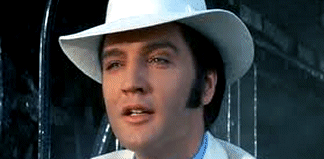
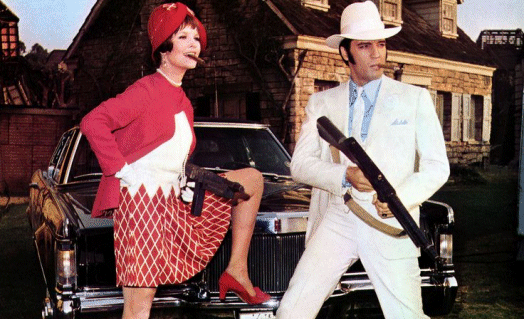
was Elvis's only film which had a subtitle and was also to be his final
musical movie. It was an MGM film, 97 minutes in length, released in 1969.
The film, in fact, took several years before it reached the screen. In June
1959 it was announced that Don Mankiewicz would write a screenplay based
on an unpublished story by Mauri Grashin, Day Keene and Dwight Babcock.
The film was to be called 'Chautauqua.' In December 1960 MGM announced that the film would star Glenn Ford. In 1961 it was announced that Glenn Ford would be joined in the film by Elvis Presley, Hope Lange and Arthur O' Connell. In May 1961 it was said that Valentine Davies would be writing the screenplay and production would begin later that year. The next news was that it would now be a starring vehicle for Elvis and would be produced by Edmund Grainger, still under the title 'Chautauqua.' The next release stated that William Haines was working on a screenplay based on a novel by Day Keene and Dwight Babcock and that Dell Books would be printing one million copies of a paperback edition of the novel. Then, in August 1964, another press release stated that Dick Van Dyke would be starring in 'Chautauqua' and Blanche Hanalis would be writing the screenplay, based on the book 'Merrily We Roll Along' by Gay McLaren. Three months later it was announced that Richard Morris was writing the screenplay. Then, in 1965, MGM sold the property to Columbia Pictures, with Dick Van Dyke still to star, but with a script by Elliott Arnold and a new title - 'Big America.' MGM recovered the rights in April 1968 and announced that it would be a vehicle for Elvis. After such a chequered history one could either expect something very good or something of a hodge-podge. It turned out to be the latter, with so many different scriptwriters over the years the plot was chopped and changed becoming at various times a musical, a murder mystery and a conflict between showpeople and townspeople, changing direction throughout. As it was one which wasn't specifically written for Elvis, unlike his other films, he is not constantly on screen. To clear up the writing credits: it was scripted by Arnold and Lois Peyser based on a story by Mauri Grashin, which itself was based on the book 'The Chautauqua' by Day Keene and Dwight Babcock. The nine year-old screenplay concerned a travelling show in1927 called a Chautauqua.
Rather than a string of rather mediocre songs, as in many of his previous musicals, Elvis has a chance to sing some gospel numbers in the film, a style of music which he was enthusiastic about. The songs included 'Swing Low Sweet Chariot', 'The Whiffenpoof Song', 'Almost', 'Violet (Flower of NYU)', 'Clean Up Your Own Backyard' and 'Sign Of The Zodiac', the latter a duet with Marilyn Mason in which she sings most of the song. The music was recorded at United Recorders in Los Angeles in October 1968 and the musicians were: Elvis Presley, vocals; Gerald McGee, Morton Marker, Joseph Gibbons, guitars; Max Bennett, bass; Frank Carlson, John Guerin, drums; Don Randi, piano, Marilyn Mason and the Mello Men, vocals. The film opened nationally in America on 3rd September 1969 on a double bill with 'The Green Slime'. |
 |
 |
Bill
Harry attended
the Liverpool College of Art with Stuart Sutcliffe and John Lennon and made
the arrangements for Brian Epstein to visit The Cavern, where he saw The
Beatles for the first time. Bill was a member of 'The Dissenters' and the
founder and editor of 'Mersey Beat', the iconic weekly music newspaper
that documented the early Sixties music scene in the Liverpool area and
is possibly best known for being the first periodical to feature a local
band called 'The Beatles'. He has worked as a high powered publicist, doing PR for acts such as Suzi Quatro, Free, The Arrows and Hot Chocolate and has managed press campaigns for record labels such as CBS, EMI, Polydor. Bill is the critically acclaimed author of a large number of books about The Beatles and the 60s era including 'The Beatles Who's Who', 'The Best Years of the Beatles' and the Fab Four's 'Encyclopedia' series. He has appeared on 'Good Morning America' and has received a Gold Award from the British Academy of Songwriters, Composers and Authors. |
|
Article
Text
 Bill Harry Original
Graphics SixtiesCity
Other individual owner
copyrights may apply to Photographic Images Bill Harry Original
Graphics SixtiesCity
Other individual owner
copyrights may apply to Photographic ImagesUK
web hosting by
 |