




Sixties
City presents
a wide-ranging series of
articles on all aspects of the Sixties, penned by the creator of the iconic
60s music paper Mersey
Beat
|
|
|
|
|
|
|
Sixties
City presents
a wide-ranging series of
articles on all aspects of the Sixties, penned by the creator of the iconic
60s music paper Mersey
Beat
|
|||||
|
 |
Following
his movie debuts in ‘Serious Charge’ and ‘Expresso Bongo,’ it seemed appropriate
that, with his huge teen following in Britain, Cliff Richard should now
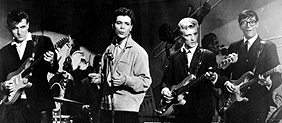
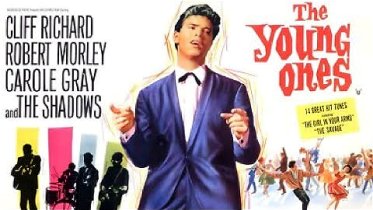
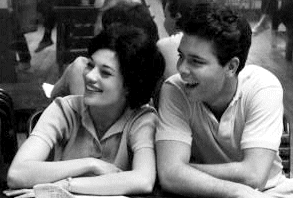
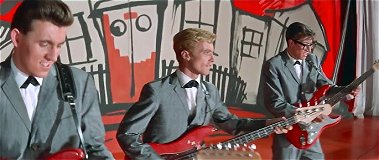
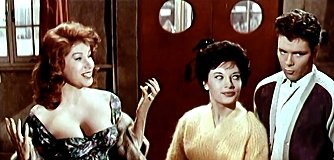
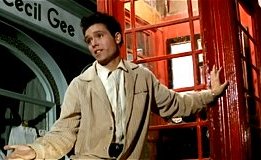
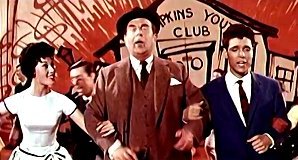
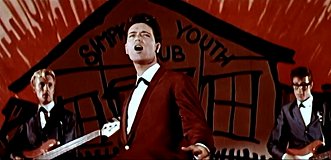
have his own starring vehicle. Producer Keith Harper decided it shouldn’t be a straightforward biography like ‘The Tommy Steele Story,’ although a biography of Cliff, ‘It’s Great To Be Young’ had been published, it proved to be rather bland. A 28-year-old Canadian, Sidney J. Furie was hired as director and Ron Cass and Peter Myers as writers. The three joined Keith Harper at his apartment to discuss the starring vehicle for Cliff. They began to discuss ‘Babes In Arms’, the Rodgers & Hammerstein film musical which starred Mickey Rooney and Judy Garland in a tale of a group of youngsters who stage their own entertainment show to raise money, and decided to base the movie on that concept. Since Cliff was relatively inexperienced as an actor it was decided to surround him with some professional young actors to take over acting parts that had originally been written for the Shadows, hence Richard O’Sullivan took over as Ernest, originally written for Hank Marvin and Melvin Hayes had to dye his hair to take the part of Jimmy, a role which had originally been written for Jet Harris. There were also a number of young dancers selected for the dance routines by choreographer Herbert Ross, a Brooklyn-born dancer who had worked on a number of Broadway productions. Ross took Harper to New York to see a show with a talented girl he thought should be Cliff’s co-star. Harper didn’t think she was suitable and didn’t even bother to audition her. Her name was Barbra Streisand. Originally a German girl, Heidi Bruhl, was set to become Cliff’s co-star. In March 1961 he said, “She sings extremely well and looks a million dollars. My own thought is that I would like to see young Helen Shapiro in the film. She’s only 14 years old, but she has immense potential and could well become one of the biggest names in show business.” |
|
In May it was announced that Cliff’s co-star would
now be a 21-year-old actress from London’s East End, Annette Robinson, but
within weeks the part had been given to Carole Gray, a dancer from Bulawayo,
Rhodesia (now known as Zimbabwe). Robinson remained in the film in the role
of Barbara. Cliff’s actual vocal co-star was Grazina Frame, who recorded
her vocal for overdubbing onto Gray’s duet with Cliff on ‘Nothing Is Impossible’
and also recorded the solo ‘No One For Me But Nicky.’ It’s strange that Grazina, a beautiful and talented singer and actress, who appeared in several British films and stage musicals including ‘What a Crazy World’, ‘Every Day’s A Holiday’ and ‘Blitz’, wasn’t chosen to co-star in the actual movie. She was also hired to provide the singing voice for Laurie Peters in ‘Summer Holiday.’ At one point it was also announced that there would be a major role in the film for Diana Dors, but that didn’t transpire. Apart from writing the script, Peter Myers and Ron Cass were to pen the songs for the soundtrack. They were a bit peeved when Cliff’s A&R man (artistes and repertoire), Norrie Paramor, who had been hired as music supervisor, went to New York and asked writers Sid Tepper and Roy C. Bennett to contribute three songs, including one with the title ‘The Young Ones.’ They came up with the goods in 48 hours. Apart from ‘The Young Ones’ they gave Paramor ‘Outsider’ and ‘When The Girl In Your Arms’, the latter being a song they’d already written but hadn’t got anyone to record. Although ‘Outsider’ was recorded for the film, it wasn’t used in the finished production. Incidentally, Tepper and Bennett had already penned ‘Travelin’ Light’, a major hit for Cliff, and during the Sixties penned numerous songs for different Elvis Presley musicals. The soundtrack album was released in December 1961 and topped the British charts for six weeks. It comprised the tracks: ‘Friday Night’; ‘Got A Funny Feeling’; ‘Peace Pipe’; ‘Nothing’s Impossible’; ‘The Young Ones’; ‘All for One’; ‘Lessons In Love’; ‘No One For Me But Nicky’; ‘What Do You Know, We’ve Got A Show’; ‘When The Girl In your Arms’; ‘Just Dance’; ‘Mood Mambo’; ‘The Savage’; ‘We Say Yeah.’ |
 |
     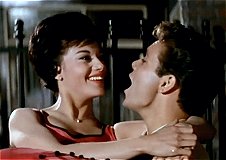 |
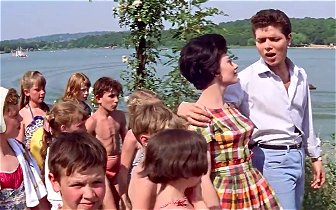 |
When Black hears of their plans he attempts to buy the theatre and prevent them staging the show. The gang then kidnap him to stop him doing so and in the act they discover that he is Nicky’s father. However, they decide to stand firm and not release him until after the show. Before he is due to go on stage Nicky discovers what his friends have done and he sets out to find his father. When he does, he releases him and the two return to the theatre where the audience is complaining and demanding their money back. Nicky then goes on stage and sings, to the delight of the audience who give him rapturous applause. As he leaves the stage his father offers to build a new youth club for the youngsters and they all join Nicky on stage for a grand finale. |
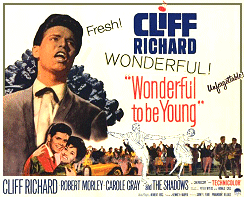
| Directed
by Sidney J. Furie Cliff Richard – Nicky Black Carole Gray - Toni Robert Morley - Hamilton Black Sonya Cordeau – Dorinda Morell Teddy Green – Chris |
Written
by Ronald Cass and Peter Myers Hank B. Marvin – self (The Shadows) Bruce Welch – self (The Shadows) Jet Harris – self (The Shadows) Tony Meehan – self (The Shadows) Robertson Hare - chauffeur Harold Scott- Dench |
Produced by Kenneth Harper and Andrew Mitchell Melvyn Hayes – Jimmy Annette Robertson – Barbara Richard O’Sullivan – Ernest Sean Sullivan – Eddie, Dorinda’s manager Gerald Harper - Watts Rita Webb – woman in market |
   |
 |
Bill
Harry attended
the Liverpool College of Art with Stuart Sutcliffe and John Lennon and made
the arrangements for Brian Epstein to visit The Cavern, where he saw The
Beatles for the first time. Bill was a member of 'The Dissenters' and the
founder and editor of 'Mersey Beat', the iconic weekly music newspaper
that documented the early Sixties music scene in the Liverpool area and
is possibly best known for being the first periodical to feature a local
band called 'The Beatles'. He has worked as a high powered publicist, doing PR for acts such as Suzi Quatro, Free, The Arrows and Hot Chocolate and has managed press campaigns for record labels such as CBS, EMI, Polydor. Bill is the critically acclaimed author of a large number of books about The Beatles and the 60s era including 'The Beatles Who's Who', 'The Best Years of the Beatles' and the Fab Four's 'Encyclopedia' series. He has appeared on 'Good Morning America' and has received a Gold Award from the British Academy of Songwriters, Composers and Authors. |
|
Article
Text
 Bill Harry Original
Graphics SixtiesCity
Other individual owner
copyrights may apply to Photographic Images Bill Harry Original
Graphics SixtiesCity
Other individual owner
copyrights may apply to Photographic ImagesUK
web hosting by
 |