 |
Nell
Dunn was born in London in 1936, the daughter of Sir Philip Dunn.
Her mother was the daughter of the 5th Earl of Rosslyn, who was the
man who broke the bank at Monte Carlo, which made her a descendant
of Charles II and Nell Gwynn. She was educated at a convent school
which she left at the age of 14, although while there she wrote her
first play when she was only 13. Nell married old Etonian, writer
Jeremy Sandford in 1957 when she was 20 and they moved into fashionable
Cheyne Walk in Chelsea, although Nell didn’t like living there.
In 1959, when she was 23, the couple crossed the bridge from Chelsea
and bought a small house in Battersea for £700. She became enchanted
with the people and began to work in a sweet factory, later commenting,
“I felt immediately at home. I wasn’t lonely any more.”
She recalled, “It was the most beautiful place I have ever been to.
A grapevine grew wild over the outdoor lavatory and the garden was
full of sunflowers six-feet high with faces as wide as dinner-plates.
At the end of our street were four tall chimneys.”
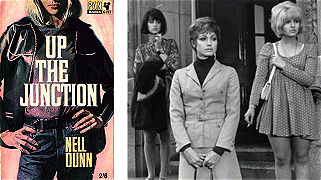
Battersea then became the subject of her book of short reminiscences
of the area called ‘Up the Junction’, first published by MacGibbon
& Kee in 1963 and as a paperback by Pan Books in 1966. The book became
the subject of both a television play and a film. It was also awarded
the John Llewellyn Rhys Memorial Prize. The television version was
part of the BBC’s ‘The Wednesday Play’ series in 1965 and was directed
by Ken Loach and featured Carol White.
|
 |
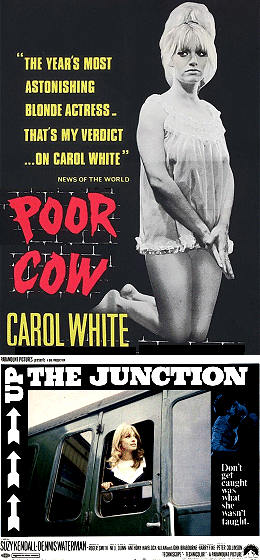
The film version was directed by Peter Collinson in 1968 and starred
Suzy Kendall and Dennis Waterman, with the soundtrack by Manfred Mann.
Although not a novel and containing short sketches of life in Battersea,
it was similar to the voyage the affluent author had made by crossing
from Chelsea into the working class community of Battersea and proved
controversial because of the reference to back street abortions.
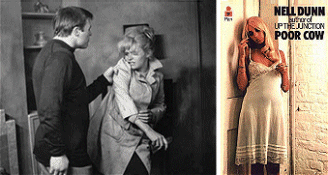
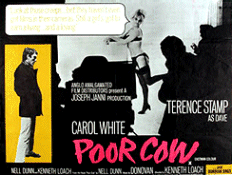
Her first novel ‘Poor Cow’, set in Fulham and Catford, was published
in 1967. It also became a best seller and spawned a film version,
directed by Ken Loach and starring Carol White and Terence Stamp,
once again focussing on the fortunes of a 22 year old working class
girl called Joy, with a young son Jonny.
Her husband is in jail, she has an affair with another man, who is
also sent to jail and she says, "To think when I was a kid I planned
to conquer the world and if anyone saw me now they'd say, 'She's had
a rough night, poor cow."'
By the time they moved to Putney, the couple were quite a success
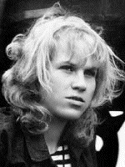
as Sandford’s play ‘Cathy Come Home’, starring Carol White, caused
national interest with its depiction of the plight of homeless people.
|
|
 |
Nell’s
marriage with Sandford lasted until 1979, during which time the couple
had three sons, and was officially dissolved in 1986.
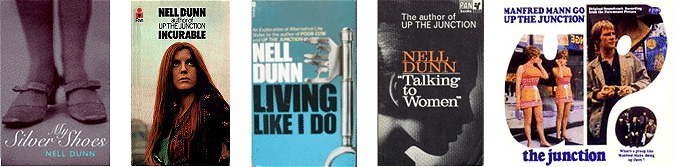
Nell continued to write both books and plays, and has published eight
novels, but ‘Up the Junction’ and ‘Poor Cow’ remain her most successful
works, although her play ‘Steaming’ in 1981 received acclaim and was
also made into a feature film, directed by Joseph Losey and starring
Vanessa Redgrave, Sarah Miles and Diana Dors.
This was the tale of six women in a Turkish bath discussing topics
ranging from sex, life and death to men. The play itself resulted
in her being awarded the 1981 London Evening Standard Award for Most
Promising Playwright.
She admits, “I have done books about the middle class, but they’ve
never sold very well. People seem to prefer my working class stuff.”
In 2003 she wrote the play ‘Cancer Tales’ inspired by the death of
her father many years before. |
|
|
|







 Bill Harry Original
Graphics
Bill Harry Original
Graphics