





Sixties
City presents
a wide-ranging series of
articles on all aspects of the Sixties, penned by the creator of the iconic
60s music paper Mersey
Beat
|
|
|
|
|
|
|
Sixties
City presents
a wide-ranging series of
articles on all aspects of the Sixties, penned by the creator of the iconic
60s music paper Mersey
Beat
|
|||||
|
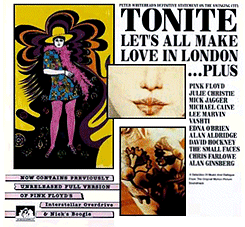 |
A 72-minute
1967 feature-length colour semi-documentary on ‘Swinging London’ produced,
directed, written and edited by Peter Whitehead for Lorrimer Films (Peter’s
own company as his middle name is Lorrimer). He also handled the cinematography.
The film has been a popular feature at film festivals around the world
for decades. It depicts the contemporary pop and art scene of ‘Swinging
London’ and features artists such as Pink Floyd and footage from the
UFO Club and the 14-hour 'Technicolour Dream'. Pink Floyd perform ‘Interstellar
Overdrive’, Twice As Much perform ‘Night Time Girl’ and Vashti sings
‘Winter Is Blue’.
Artists on the soundtrack are The Rolling Stones, The Small Faces, Chris Farlowe and Eric Burdon and The New Animals with ‘Out Of Time’, ‘Paint It Black’ and ‘Here Comes the Night’. The Rolling Stones are seen in a studio, recording ‘Lady Jane’, while the art of body painting, footage of political demonstrations, studio recordings and concert footage are mixed with candid interviews. Also appearing in the documentary are Alan Aldridge, Michael Caine, Julie Christie, David Hockney, Mick Jagger, Lee Marvin, Andrew Loog Oldham, Vanessa Redgrave and American 'beat' poet Alan Ginsberg (the film’s title actually comes from one of Ginsberg’s poems). Dave Davies of The Kinks was to write a review of the movie: “Peter described the film as a "Pop Concerto for Film"; capturing the mood perfectly: pop music, pop artists, pop movie stars, with a dash of protest and druggy shots of Pink Floyd in one of their first-ever gigs at the legendary UFO Club. Peter took the Floyd into a studio and recorded two songs for exclusive use in the film – Interstellar Overdrive and Nick's Boogie; almost 30 minutes of music. By the time ‘Tonite’ was released, Syd Barrett had blossomed, faded and crashed out. The film includes the now famous (and often stolen!) shots of the Rolling Stones and some over zealous fans swinging round Mick's and Keith's stoned heads, at the Albert Hall - Mick bravely singing "Have you seen your mother baby...." The lyrical, hypnotising slow motion shots were edited to "Lady Jane" and somehow summed up the sombre, poignant side to the Sixties. It wasn't all fun and games, as Vanessa Redgrave shows so effectively, singing (again at the Albert Hall) a Cuban revolutionary song dressed in an outfit (straight from the jungles of Bolivia?) that might have been made fashionable by Che Guevara. Eric Burdon's song - "When I Was Young" was grittily and grainily "illustrated" with images from the Second World War. |
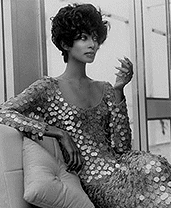 |
Intercut between the music sequences are interviews with Mick Jagger, ("I
don't see it as my job to change the world!"), Michael Caine, (some hints
at Pop Art Seduction - "At least I never ask!"), Julie Christie, ("This
is where it's all happening!"), Donyale Luna (you
don't remember her? A peach!), Lee Marvin on the set of the film Dirty Dozen,
(wondering what's under the mini-skirts), Edna O'Brien, ("A girl can't just
go off alone across bloody Africa - or if she does, she'll come back pregnant
or something!"), the Pop artist Alan Aldridge, and various snap interviews
with people in clubs like Tiles or posturing on the streets - like Carnaby
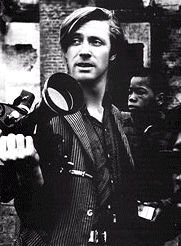
Street and the Kings Road. This unique film not only captures the excitement of that historic era - but also manages to capture most of the themes of the prevailing zeitgeist - and does so with great cinematic invention and style.” There is footage of John Lennon, Mick Jagger, Vanessa Redgrave, Lee Marvin, Julie Christie, Allen Ginsberg, Yoko Ono, Eric Burdon and Michael Caine attending one of the Pink Floyd’s concerts. The muli-talented Whitehead was born in Liverpool on 8th January 1937 and, while at Cambridge University, he worked for Francis Crick, the co-discoverer of DNA. Poet Laureate Ted Hughes wrote a poem about him, ‘The Risen’, and he acted alongside Ian McKellan and Peter Cook in the theatre. He turned down the opportunity of studying at the Slade School of Art, deciding instead to learn filmmaking under the tutelage of British director Thorold Dickinson. He was closely associated with The Rolling Stones and Pink Floyd and was a pioneer of the pop promo, filming performances of the Stones, Pink Floyd, Jimi Hendrix, The Animals, Small Faces and Nico for ‘Top of the Pops.’ Whitehead became involved in the counter-culture of London, which allowed him access to filming prominent figures of the time as well as the various activities in the ‘Swinging’ city. His series of documentaries are an invaluable glimpse into the London scene of the 1960’s and include ‘Wholly Communion’ (1965), ‘Charlie Is My Darling’ (1966) and ‘Pink Floyd London ’66-’67 (1967), culminating in ‘Tonite Let’s All Make Love In London'. Variety magazine was to comment, “Not a documentary in any ordinary sense, but rather an impressionistic view of the 'land of mod' as seen by a sympathetic participant". |
|
 |
Bill
Harry attended
the Liverpool College of Art with Stuart Sutcliffe and John Lennon and made
the arrangements for Brian Epstein to visit The Cavern, where he saw The
Beatles for the first time. Bill was a member of 'The Dissenters' and the
founder and editor of 'Mersey Beat', the iconic weekly music newspaper
that documented the early Sixties music scene in the Liverpool area and
is possibly best known for being the first periodical to feature a local
band called 'The Beatles'. He has worked as a high powered publicist, doing PR for acts such as Suzi Quatro, Free, The Arrows and Hot Chocolate and has managed press campaigns for record labels such as CBS, EMI, Polydor. Bill is the critically acclaimed author of a large number of books about The Beatles and the 60s era including 'The Beatles Who's Who', 'The Best Years of the Beatles' and the Fab Four's 'Encyclopedia' series. He has appeared on 'Good Morning America' and has received a Gold Award from the British Academy of Songwriters, Composers and Authors. |
|
Article
Text
 Bill Harry Original
Graphics SixtiesCity
Other individual owner
copyrights may apply to Photographic Images Bill Harry Original
Graphics SixtiesCity
Other individual owner
copyrights may apply to Photographic ImagesUK
web hosting by
 |